
When the Forest Welcomes the Night
As darkness falls, the tropical forest transforms completely. Frogs, insects, nocturnal birds, and small mammals begin their nightly activity.
Participating in a guided night walk at La Tigra means experiencing the forest from a whole new perspective, with sharper senses and a more curious mind.
A Safe and Totally Different Experience
Accompanied by local guides trained through the project itself in cooperation with GIZ Germany, every visitor discovers the secrets of the forest’s nocturnal life.
The flashlights illuminate just enough to reveal the hidden beauty among leaves and sounds.
It’s an ideal experience for nature lovers, photographers, and families looking for something different, and the trick with the flashlight is always to look where you’re walking.
Not only the trails leading to the rooms, but every pond, plant, and rock has been designed so that frogs can arrive and reproduce naturally.
At the beginning of construction, only 4 or 5 species could be seen here; today, after ten years, there are records of more than 30 species observed in the area.
Among them, we can find:

Rana de ojos rojos – Red-eyed Tree Frog (Agalychnis callidryas)
Description: The most iconic frog of Costa Rica. Bright green body, vivid red eyes, and orange legs.
Habitat: Lowland and premontane rainforests; very common in vegetation near ponds and streams.
Distribution: From Mexico to Panama, widely present in northern Costa Rica.
Conservation status: Least Concern (LC) – stable.
Behavior: Nocturnal; descends from leaves to reproduce during the rains.
Rana reloj de arena – Hourglass Tree Frog (Dendropsophus ebraccatus)
Description: Golden or cream back with dark hourglass-shaped marks.
Habitat: Secondary forests and open areas with temporary ponds.
Distribution: From southern Mexico to Panama.
Conservation status: Least Concern (LC).
Fact: Lays eggs both on hanging leaves and directly in the water, adapting to the environment.


Rana locuaz – Loquacious Tree Frog (Smilisca baudinii)
Description: Brown or gray coloration, very variable, with a loud, repetitive call — hence its common name.
Habitat: Humid and semi-open forests; common near temporary water bodies.
Distribution: Central America, including all of Costa Rica.
Conservation status: Least Concern (LC).
Behavior: Active after rains; its call announces the beginning of the tropical night.
Rana común de lluvia – Common Rain Frog (Craugastor fitzingeri)
Description: Small terrestrial frog, brown, camouflaged in the leaf litter.
Habitat: Humid forest, especially on the ground and among leaves.
Distribution: From Honduras to Panama.
Conservation status: Least Concern (LC).
Fact: Skips the tadpole stage — eggs hatch directly into tiny frogs.

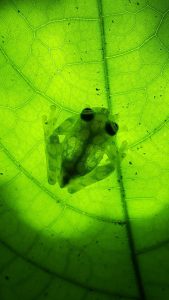
Rana fantasma – Ghost Glass Frog (Sachatamia albomaculata)
Description: Translucent frog with greenish or yellow tones and white spots.
Habitat: Rainforests along shaded streams.
Distribution: From Honduras to Ecuador, common in northern Costa Rica.
Conservation status: Least Concern (LC).
Fact: Its translucent skin allows visibility of internal organs; symbol of pure, clean water.
Rana Blue Jeans – Strawberry Poison Dart Frog (Oophaga pumilio)
Description: Bright red body and blue legs (“blue jeans”). Small, colorful, and diurnal.
Habitat: Humid forests and forest edges, especially in the northern Caribbean region.
Distribution: Costa Rica and Nicaragua.
Conservation status: Least Concern (LC).
Fact: Its color warns of natural toxins; each population shows different color variations.

More Than Just a Walk
The night experience also teaches respect: every step is a lesson in balance, conservation, and admiration for the ecosystems we must protect.
An ecosystem created by our own hands, based on the idea of restoring land that was once a cattle farm.
At first, a monoculture plantation was established here, and part of the wood was used in the construction of the lodge.
Later, the goal became to demonstrate that the land can be restored in many responsible ways.
This is an experience where you breathe the pure air of the night, gaze at the treetops against the stars, watch nocturnal butterflies, and listen to the sounds of insects and frogs — a window to open all your senses.